
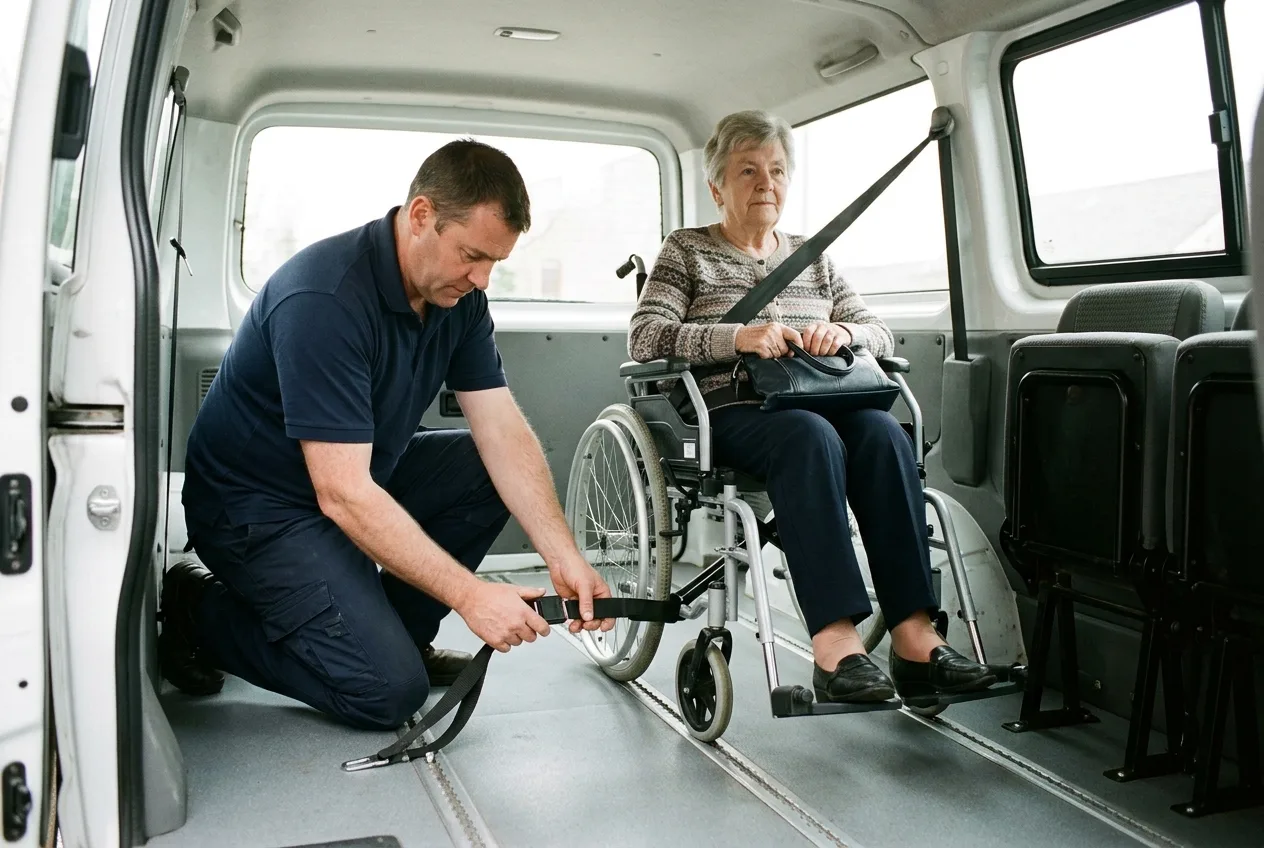
Why the chair and the passenger are secured separately
During a wheelchair ride, you stay seated in your own manual or power chair from pickup to drop-off. Because a wheelchair is built for rolling rather than absorbing vehicle stops, securing a ride takes two distinct steps. First, heavy straps anchor the wheelchair frame to metal tracks in the van floor. Second, a separate vehicle lap-and-shoulder belt goes around you. If a belt only attaches to the chair, the frame has to bear the force of both its own weight and yours during a sudden stop. Anchoring both directly to the van floor keeps the chair still and protects your body independently.
How a four-point tie-down holds the frame
A four-point tie-down uses two heavy retractable straps at the front of the wheelchair and two at the rear. Every Juniper driver receives formal training in wheelchair securement before taking rides on the road.
- Solid frame attachment: Straps hook onto welded frame points or manufacturer transit brackets, never onto removable footrests, armrests, or wheels.
- Balanced floor tension: Once all four hooks lock into the floor track, the straps tighten evenly so the chair cannot tip, slide, or swivel around corners.
Why your posture belt does not replace a vehicle seatbelt
Many wheelchairs have a lap strap or chest harness to help with daily posture and positioning. While helpful indoors, posture belts are not crash-tested for road travel. After locking the four floor straps, the driver places a vehicle-mounted lap-and-shoulder belt across your pelvis and collarbone, connecting it to the van structure. Your posture strap stays buckled underneath if you use one, while the vehicle belt handles road forces. For power chairs, turning the controller power off once parked prevents accidental joystick movement while the driver fastens the belts.
Ramp vans, lift vans, and chair width limits
Juniper operates ten standard wheelchair vans across the Las Vegas valley, including six rear-ramp vans and four side-lift vans. Both styles accommodate manual and power wheelchairs up to 30 inches wide, measured from the widest outer point of the wheels or armrests. If your chair exceeds 30 inches or you need higher weight capacity, our two bariatric vans feature a 1,000-pound lift and wider floor securement, with exact dimensions confirmed at booking. If you do not own a chair, we can also supply a transport wheelchair for the trip when requested ahead of time.
Details to share with your scheduler before pickup
Sharing a few specifics when you request your ride at least 48 hours ahead helps our schedulers assign the best van for your setup.
- Chair type and width: Let us know whether you use a manual or power chair and confirm if it measures under or over 30 inches wide.
- Entry path: Every wheelchair pickup requires a step-free path from your door to the van, since drivers do not lift passengers or carry chairs over stairs.
- Portable gear: Tell us if you bring self-managed portable oxygen so the driver can secure the tank safely in the cabin.
Knowing how floor straps and belts work makes boarding straightforward. Call (702) 000-0000 Monday through Saturday or send an online request at least 48 hours ahead, and a scheduler will confirm vehicle availability and pricing.